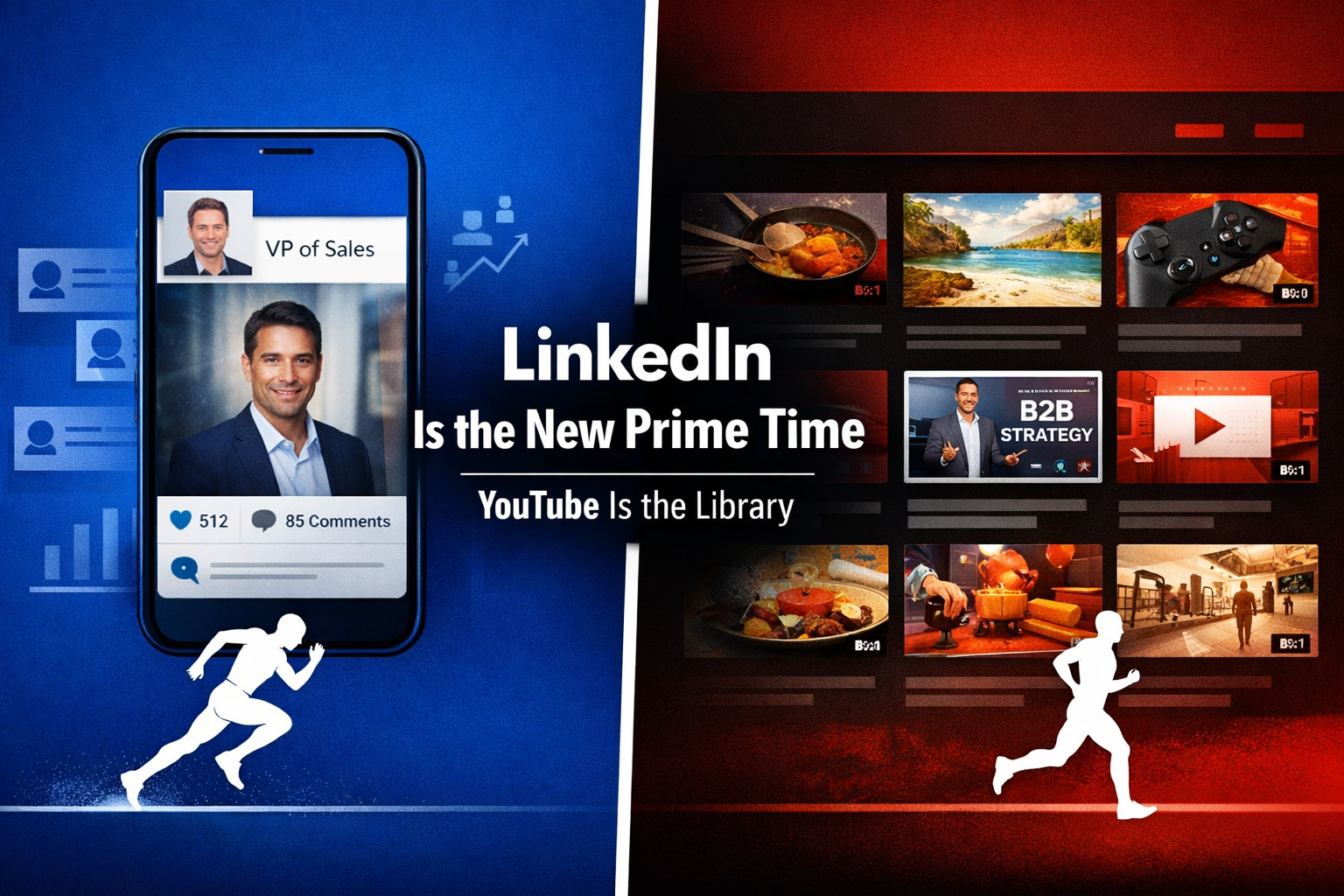
Most people measure platforms by size. YouTube has 2.53 billion users, processes 3 billion searches a month, and has a decade's head start. By that measure, LinkedIn isn't even close.
But size is the wrong scorecard for B2B.
The right question is this: when your video plays, who's watching, and what happens next? That's where the comparison flips entirely. And that's where LinkedIn is winning.
The mindset in the room changes everything
When someone opens YouTube, they're in entertainment mode. They want to be informed, sure, but they're also watching cooking videos, travel vlogs, and commentary from creators they follow for fun. Even if your B2B explainer is excellent, it's competing with everything the algorithm throws at them next.
When someone opens LinkedIn, they're in a completely different headspace. Work. Opportunity. Industry. They're looking for things that make them look smarter, move faster, or think differently about their field. A "good enough" video on LinkedIn in that context will outperform a polished YouTube video aimed at the same person , because the context is already doing half the work.
And then there's the frame around the video itself. On LinkedIn, your face, your name, your title, and your company are right there. Every comment from another professional adds social proof. The video doesn't exist in isolation, it's surrounded by your credibility. YouTube gives you none of that by default.
The algorithm is now explicitly on LinkedIn's side
LinkedIn's algorithm in 2026 prioritizes three things above everything: native video over shared links, dwell time over passive impressions, and authentic engagement over raw reach.
This is not subtle. Posting a YouTube link on LinkedIn now actively suppresses your reach. LinkedIn wants content to live on LinkedIn, and it rewards you generously when it does. Native video on the platform currently averages a 5.6% engagement rate, beating every static format. Video impressions grew 73% year-over-year. Total views hit 154 billion in 2024 alone.
More importantly, one strong video doesn't just reach your followers. Engagement from your connections pulls it into second-degree networks i.e. across industries, geographies, and seniority levels, without you spending a dollar on distribution.
The audience is pre-filtered
Here's the uncomfortable truth about YouTube for B2B: you have almost no control over who watches your content organically. You can optimize titles and thumbnails, but you're largely at the mercy of what the algorithm serves.
On LinkedIn, the professional graph does the filtering for you. Director-level and above decision-makers account for 46% of total LinkedIn video likes and shares. 61% of the platform's video-viewing audience works in B2B companies. 67% of all video interactions come from people with five or more years of work experience.
That's not an audience. That's a buyer persona.
When someone watches your video on LinkedIn, you know they have a job title, a company, a seniority level. You can see it. You can DM them. The gap between "watched your video" and "had a conversation" is dramatically shorter than anything YouTube can offer.
The honest trade-off
LinkedIn wins on velocity. A strong video peaks fast, often within 48 to 72 hours, and drives immediate attention, profile visits, connection requests, DMs, and inbound interest. It's the sprint.
YouTube wins on longevity. A well-optimized video keeps compounding for months, even years, through search rankings and recommendations. It's the marathon.
Most B2B brands are running the marathon on LinkedIn and the sprint on YouTube, completely backwards.
The practical framework: use LinkedIn as your testing ground and distribution engine. Short, direct, on-camera. 30 to 90 seconds for discovery, 2 to 5 minutes for audiences who already know you. Watch what resonates with actual decision-makers. Then take what proved its point and build the YouTube long-form around it.
Shoot once. Cut long-form for YouTube. Slice for LinkedIn with hooks tailored to a professional audience. One piece of content, two completely different jobs.
What to actually measure
View count is the wrong metric on LinkedIn. What matters is saves, shares, qualified comments, profile visits after the video, and DMs opened because of it. One well-performing LinkedIn video can trigger a cascade. Speaking invitations, connection requests, inbound from people who've been watching silently for weeks, and deals that started with "I saw your video."
None of that shows up in a view counter. All of it shows up in revenue.
The window is open, but not forever
The comparison to early YouTube keeps coming up for a reason. Right now, LinkedIn video has low competition, high algorithmic favor, and an audience that is actively engaged. The brands and founders moving now are building authority cheaply, the same way early YouTube creators built audiences before the platform got crowded.
That window doesn't stay open. It never does.
LinkedIn isn't replacing YouTube. But for B2B, for professional services, for anyone selling to decision-makers, LinkedIn video is where attention converts. YouTube is where it compounds.
That window doesn't stay open. It never does
%20-%20Copy.png?width=350&height=98&name=Logo%20(1)%20-%20Copy.png)